Overcoming blurred accountability and logistics risks so engineering and procurement teams can refocus on core product innovation.
In the journey of transitioning a hardware product from development to mass production, transforming design blueprints into physical products is often fraught with unforeseen challenges. For procurement decision-makers and R&D engineers at tech companies, the most daunting hurdle is rarely the technology itself—it is the overwhelming communication and integration overhead inherent in supply chain management. In traditional hardware manufacturing model, teams often split the production among multiple vendors: PCB fabrication and PCBA assembly go to electronics manufacturing suppliers, enclosure tooling to a mechanical supplier, and final box build assembly and testing to another assembly facility. However, this fragmented, multi-vendor sourcing model often creates unexpected bottlenecks during the final mile before market launch.
The Hidden Costs of Fragmented Sourcing
In practice, sourcing components separately may seem like an easy way to secure the lowest unit price for each process. However, when it comes time for full system assembly, hidden risks and costs quickly bubble to the surface:
• Blurred Accountability (The Blame Game): When issues arise during final functional testing, each supplier may conclude that the problem falls outside its scope. The PCBA supplier claims the board is flawless, while the enclosure supplier insists the dimensions are within tolerance. Caught in the middle, the client’s engineering team must invest substantial time in cross-vendor coordination and root-cause analysis.
• Exorbitant Communication and Schedule Overhead: Managing multiple vendor contacts—often across different time zones and languages—drains immense management energy. Simply aligning specifications, adjusting mechanical tolerances, and synchronizing schedules can paralyze engineers and buyers, inevitably slipping the project timeline.
• Heightened Logistics and Quality Risks: Constantly shuffling work-in-progress materials between factories inflates packaging and freight costs. More critically, it dramatically increases the risk of sensitive electronic components suffering moisture damage, mechanical shock, or electrostatic discharge during transit.
What Is "Box Build Assembly"?
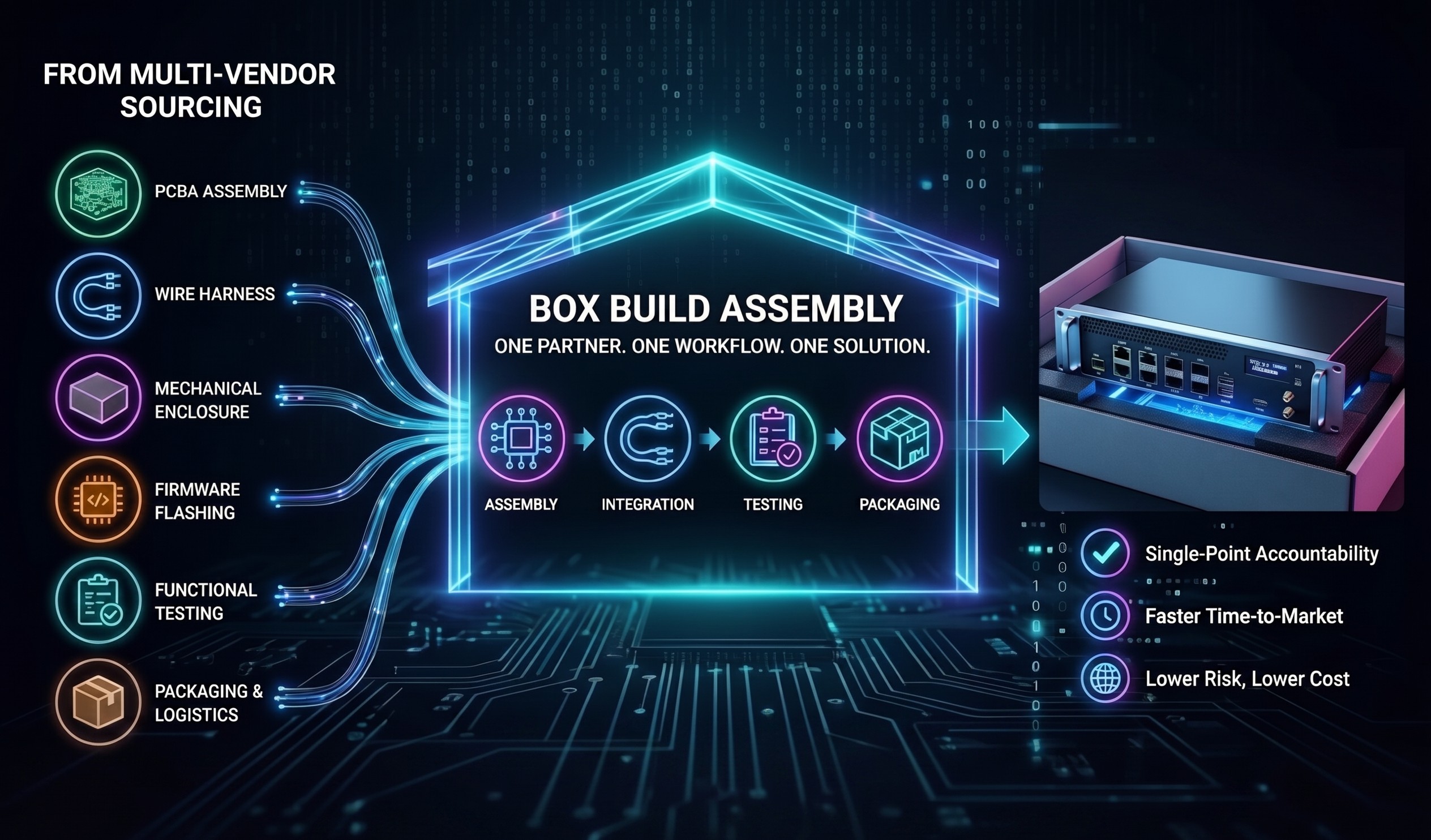
To address these pain points, the electronics manufacturing services industry has developed a more systematic, one-stop solution: Box Build Assembly (also known as full system integration). Box Build Assembly means the manufacturing partner moves beyond basic PCBA board assembly. Instead, they integrate board assembly, wire harness connections, enclosure fitting, firmware flashing, functional testing, and final custom packaging—all under one roof in a single, unified workflow. This means that when the product leaves the facility, it is no longer just a collection of sub-assemblies requiring further processing, but a fully finished, shelf-ready product ready for end users.
The Core Value of Turnkey Box Build Integration
For development teams prioritizing efficiency and quality, a turnkey Box Build manufacturing partner offers two crucial advantages: Deep System-Level Integration and Single-Point Accountability.
• System-Level Mechanical Assembly: Assembling PCBA modules and mechanical enclosures under one roof allows engineers to immediately catch and resolve mechanical interference or tolerance stack-up issues, ensuring flawless aesthetic and structural precision.
• Integrated Programming & Functional Testing: From SMT manufacturing and software programming to final end-of-line functional testing, the entire cycle follows a standardized quality management system to guarantee consistent yield rates for every shipped unit.
• Integrated Packaging & Global Logistics: Immediately following testing, units undergo custom protective packaging built to international shipping standards. Depending on the service model, they can then be shipped to designated warehouses or distribution points, reducing inter-factory transfers and shortening the overall supply chain process.
Refocusing on Core Product Innovation
Does your hardware project really need Box Build Assembly? Ultimately, it comes down to balancing time-to-market against management overhead. When R&D and procurement teams reduce the burden of cross-factory communication, accountability clarification, and logistics tracking, they can redirect valuable time and resources toward product marketing and core technology innovation. Choosing a highly integrated Box Build partner not only simplifies the supply chain, but also provides an important strategy for bringing products to market reliably, efficiently, and at scale.